
From artificial intelligence continuously pushing the boundaries of technology, to commercial space entering a stage of industrialized development; from the ongoing upgrading of high-end manufacturing, to the rapid growth of strategic emerging industries such as new energy, new materials, and biotechnology, technological innovation is reshaping the global industrial landscape at an unprecedented pace.
In the past, technological innovation was more often understood as a single technology or invention. Today, it has become an important force driving industrial upgrading, optimizing resource allocation, and reshaping the global competitive landscape. More and more countries are treating technological innovation as a core strategy for future development, building industrial chains around innovation chains and improving innovation chains around industrial chains, so that technological breakthroughs can continuously turn into industrial advantages and innovation achievements can keep releasing economic value.
From market data, technological innovation is shifting from conceptual enthusiasm to real industrial scale. Data released by the World Intellectual Property Organization and Trade Data Monitor show that global high-tech exports reached approximately USD 4.9 trillion in 2025, up nearly 14% year on year, with growth close to three times the overall growth rate of global trade. This growth was driven not only by AI data centers, advanced chips, and computing hardware, but also by high-tech fields such as robotics, aerospace, biotechnology, and pharmaceuticals. This shows that a new round of technological innovation is becoming an important variable in global economic growth through trade, industrial chains, and capital flows.
In SHINDEV’s view, the new round of technological revolution has entered a stage of deep integration. What truly determines future competitiveness is no longer leadership in a single technology, but whether innovation elements such as technology, industry, capital, and talent can form efficient synergy and build a sustainable innovation ecosystem.
Looking back at the history of global industrial development, almost every major industrial transformation began with technological innovation.
The steam engine drove the Industrial Revolution, the internet reshaped business models, and mobile communications changed the way people connect with the world. Today, a new round of technological revolution represented by artificial intelligence, advanced manufacturing, commercial space, and the digital economy is opening a new industrial cycle.
At the same time, the meaning of technological innovation continues to expand. From scientific research results in laboratories, to manufacturing upgrades on production lines, and then to digital applications across industries, innovation now runs through every link of industrial development.
This means that future industrial competition will not only be about R&D capability, but also about forward-looking deployment, resource integration, and innovation system building. Whoever can identify future trends earlier and take the lead in coordinating technology, industry, and markets will have a greater chance of capturing the next round of development opportunities.
SHINDEV has always based its approach on global industrial research, continuously tracking development trends in frontier fields such as artificial intelligence, semiconductors, high-end manufacturing, green energy, and the digital economy. By observing future economic logic through industrial changes, SHINDEV seeks a clearer direction for long-term value creation.
Technological innovation never happens in isolation.
The birth of every original technology and the growth of every innovative company depend on development soil formed through long-term accumulation.
In recent years, the world has continued to increase investment in computing infrastructure, digital networks, advanced manufacturing capabilities, green energy systems, and other fields, constantly improving the basic conditions for technological innovation. From data centers to smart factories, from high-performance chips to new energy networks, these foundational capabilities are becoming important support for new quality productive forces.
Infrastructure investment is also providing a stronger foundation for technological innovation. In its Energy and AI report, the International Energy Agency expects global data center electricity demand to reach about 945 TWh by 2030, more than doubling from current levels. Among this, electricity demand from AI-optimized data centers is expected to grow more than fourfold by 2030. This means that the development of artificial intelligence is driving the upgrading of an entire infrastructure system, including computing power, chips, energy, power grids, cooling systems, and data centers. Competition in innovation ecosystems is no longer only competition in technology itself, but also competition in infrastructure capacity and system coordination.
At the same time, more and more innovation participants are emerging. Technology companies continue to improve R&D capabilities, research institutions are strengthening original technology breakthroughs, entrepreneurial innovation teams are growing rapidly, and collaboration across upstream and downstream industrial chains is deepening, forming a more open and dynamic innovation ecosystem.
Only when the foundation is continuously strengthened and participants remain active can technological innovation maintain a steady flow of development momentum.
Talent has always been the most active and critical variable in the innovation system.
As global technology competition deepens, high-end talent has become an important strategic resource that countries are competing to secure. From AI algorithm engineers to chip design experts, from interdisciplinary talent in advanced manufacturing to innovation teams with both industrial understanding and international vision, talent is determining how far a technology can go and how high an industrial chain can develop.
In the future, competition for innovation resources will essentially also be competition for talent resources.
The significance of technological innovation does not lie in remaining in papers and patents, but in continuously entering real industrial scenarios, solving practical problems, and creating long-term value.
In recent years, technologies such as artificial intelligence, big data, robotics, and new energy have continued to accelerate industrialization. More and more innovation achievements have moved from research to market, from technology to product, and from product to industry, forming new points of economic growth.
From the perspective of industrialization outcomes, technological innovation is accelerating its entry into real application scenarios. WIPO data show that in the first 11 months of 2025, global industrial robot exports increased by 12.3%, while aerospace-related exports grew by 15.7%. At the same time, exports of peptide, protein, and glycoprotein hormone products increased by 151.1%, reaching USD 98.9 billion, reflecting the rapid release of commercial demand for innovative drugs and biotechnology products. These changes show that the value of innovation does not only exist in laboratories, papers, and patents. Only by entering real industrial scenarios such as manufacturing, healthcare, energy, aerospace, and the digital economy can it generate sustained economic value.
Commercial space is also gaining clearer market validation. Space Capital data show that global private investment related to the space economy reached USD 55.3 billion in 2025, up 65% from 2024. Capital flows are shifting from early exploratory projects toward areas with stronger commercialization potential, such as communications, remote sensing, navigation, defense resilience, and space data applications. With the accelerated development of low Earth orbit satellites, satellite internet, remote sensing data, and space information services, the space industry is gradually moving from high-threshold engineering toward a new type of infrastructure that is applicable, operable, and scalable.
In this process, the industrial chain becomes an important carrier for transforming technological achievements.
A technology can only achieve scaled application after entering the industrial chain. An industry can only continue to improve competitiveness by constantly absorbing innovation achievements. The more closely the innovation chain and industrial chain are integrated, the faster technological innovation can release value.
Therefore, technological innovation and industrial development are not two parallel lines, but a community that empowers and promotes each other.
SHINDEV believes that innovation with real long-term vitality does not only drive the growth of one company. It can also promote coordinated development across upstream and downstream sectors, form industrial clustering effects, and continuously release greater social and economic value.
Every major technological innovation requires long-term investment and the support of patient capital.
From a global perspective, whether it is the development of the artificial intelligence industry or the rapid rise of semiconductors, high-end manufacturing, commercial space, and other fields, all are inseparable from the continuous allocation of capital to innovation resources and strong support from the technology finance system for industrial development.
Capital flows also confirm this trend. The IEA’s World Energy Investment 2025 estimates that global energy investment will reach USD 3.3 trillion in 2025, of which clean energy technology investment will be about USD 2.2 trillion, twice the level of fossil fuel investment. Clean energy, energy storage, power grids, nuclear energy, low-emission fuels, and electrification solutions are becoming important directions for global capital allocation. For AI computing power, high-end manufacturing, and digital infrastructure, the upgrading of energy systems has become a key prerequisite for industrial development.
The value of capital is not only reflected in funding.
More importantly, through resource integration, industrial connection, strategic coordination, and global allocation capabilities, capital can help technological achievements enter the market faster, help innovative companies integrate into industrial chains more quickly, and promote the continuous transformation of technological advantages into industrial advantages.
This is also the significance of the continuous development of technology finance.
SHINDEV has always believed that capital should not stop at discovering value, but should be committed to cultivating and amplifying value. Capital with a truly long-term perspective should go deep into industrial research, pay attention to technological development trends, systematically allocate resources around innovation, and build a more efficient bridge among corporate growth, industrial upgrading, and technological innovation.
When capital and technology form a positive interaction, and when financial resources serve the real economy more precisely, the vitality of innovation development can be continuously released.
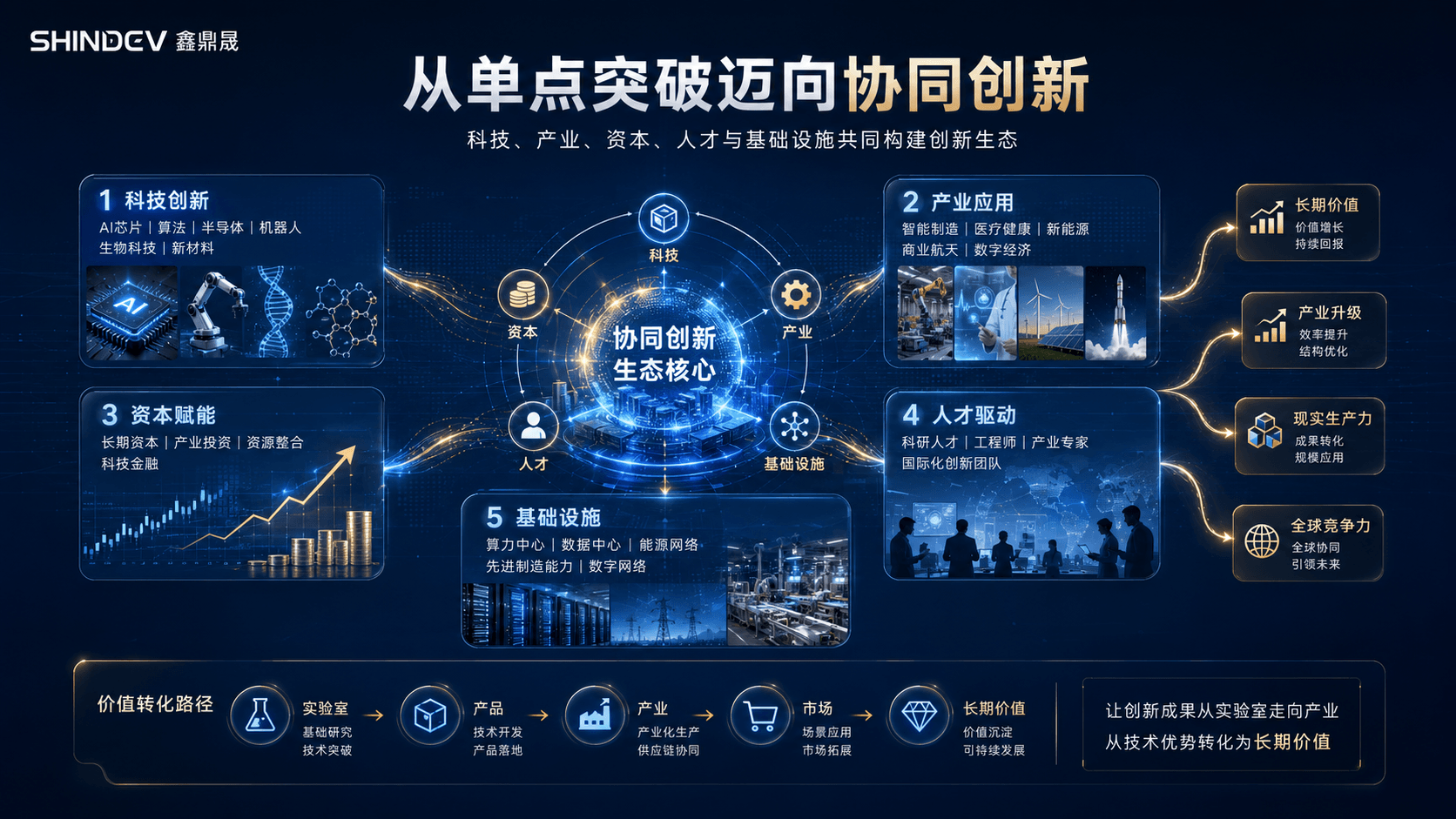
Today, technological innovation increasingly depends on open cooperation.
The connections among enterprises, universities, research institutions, industrial platforms, financial institutions, and application scenarios are becoming stronger. Innovation has evolved from past single-point breakthroughs into a development model involving multiple participants and coordinated interaction among multiple factors.
The building of an innovation community is not only about resource sharing, but also the deep integration of the innovation chain, industrial chain, capital chain, and talent chain.
Only by continuously strengthening collaborative innovation mechanisms and promoting closer interaction among research, industry, capital, and markets can the efficiency of transforming technological achievements be improved, and more innovation outcomes be brought into industry and society.
Facing a new global pattern of industrial competition, collaborative innovation has become an important path for promoting high-quality development.
Technological innovation has no endpoint, and industrial upgrading will never stop.
Standing at the historical juncture of a new round of technological revolution and industrial transformation, innovation has become an important engine of economic growth and a key direction of continuous attention for global capital.
In the future, as artificial intelligence, advanced manufacturing, the digital economy, green energy, biotechnology, and other fields continue to break through, technological innovation will further promote the optimization of industrial structures, the upgrading of resource allocation, and the reshaping of the global industrial system, bringing broader development space to the world economy.
From the growth of global high-tech trade to the expansion of AI data centers and computing infrastructure; from record-high clean energy investment to the accelerated industrialization of commercial space, biotechnology, industrial robotics, and other fields, the market is using real data to show that technological innovation is no longer just a future narrative. It is forming a new industrial foundation, new capital flows, and new growth space.
Looking ahead, SHINDEV will continue to build on a global perspective and uphold a long-term development philosophy. It will continue to focus on frontier trends in technological innovation, conduct in-depth research into the laws of industrial evolution, actively play the role of capital as a bridge connecting technology, industry, and resources, promote the deep integration of innovation chains and industrial chains, and accelerate the transformation of technological achievements into real productive forces.
Moving toward the new is a choice that follows the development of the times. Driving the future through innovation is a commitment to long-term value.
SHINDEV is willing to move forward with more innovative forces, discover opportunities in technological progress, create value in industrial transformation, and jointly write a new chapter of high-quality development.