

Shanghai, July 2026 — The 2026 World Artificial Intelligence Conference and High-Level Meeting on Global AI Governance was held in Shanghai from July 17 to 20. Under the theme “AI Partnership for a Brighter Future,” the conference focused on AI technology development, global governance, industrial collaboration, and international cooperation.
According to publicly available conference information, this year’s event brought together official representatives, industry leaders, academics, and research institutions from more than 100 countries and international organizations. Chinese President Xi Jinping attended the opening ceremony and delivered a keynote address. Kazakhstan President Kassym-Jomart Tokayev, Cambodian Prime Minister Hun Manet, Thai Prime Minister Anutin Charnvirakul, and United Nations Secretary-General António Guterres also attended related activities. During the conference, official representatives from 102 countries and international organizations participated, alongside 1,568 Chinese and international experts, including 432 overseas guests, as well as leading global scholars such as Turing Award, Nobel Prize, and Fields Medal laureates.
This was not only a high-level global gathering in the field of artificial intelligence, but also a clear signal that AI is moving from technological competition toward industrial collaboration, joint rule-building, and ecosystem competition. For financial capital, the development of the AI industry is no longer merely an investment opportunity. It has become an important mission of the era: serving technological innovation, promoting industrial upgrading, and advancing the global allocation of resources.
In SHINDEV’s view, the AI industry is entering a critical window of development. The role of capital can no longer remain limited to funding alone. Through the coordination of financial resources, industrial resources, technological resources, and global market resources, capital must help AI move from the laboratory to industry, from technological achievement to commercial value, and from isolated breakthroughs to a closed-loop ecosystem.
The convening of this World Artificial Intelligence Conference marks a new stage in global AI development, one in which technological advancement and governance coordination are equally important.
The Chair’s Statement of the 2026 World Artificial Intelligence Conference and High-Level Meeting on Global AI Governance, released by China’s Ministry of Foreign Affairs, stated that artificial intelligence is comprehensively reshaping human economic and social development models, and will continue to inject new momentum into industry, people’s livelihoods, and scientific research. During the conference, representatives from 29 countries signed the Agreement on the Establishment of the World AI Cooperation Organization and became its founding members, further showing that AI governance, AI cooperation, and inclusive AI have become shared global issues.
From an industrial perspective, AI is no longer simply a contest of model capabilities. Behind it are computing infrastructure, data resources, algorithm platforms, the semiconductor industry, energy systems, application scenarios, and global governance rules. Whoever can organize these elements more efficiently is more likely to take the initiative in the next round of industrial transformation.
From the perspective of Chen Rui, Co-founder and Chief Strategy Officer of SHINDEV, the most important change in the AI industry today is that its value logic is shifting from “technological breakthrough” to “industrial restructuring.” AI is no longer only a research and development direction for technology companies. It is becoming a foundational capability that drives upgrading across manufacturing, finance, healthcare, energy, transportation, education, urban governance, and other industries.
This means financial capital must redefine its role. In the past, capital paid more attention to corporate valuations, market themes, and phased growth. In the AI era, capital must better understand technology roadmaps, positions in the industrial chain, commercialization paths, and ecosystem coordination capabilities. Capital with true long-term value does not merely discover opportunities; it participates in the formation of those opportunities.
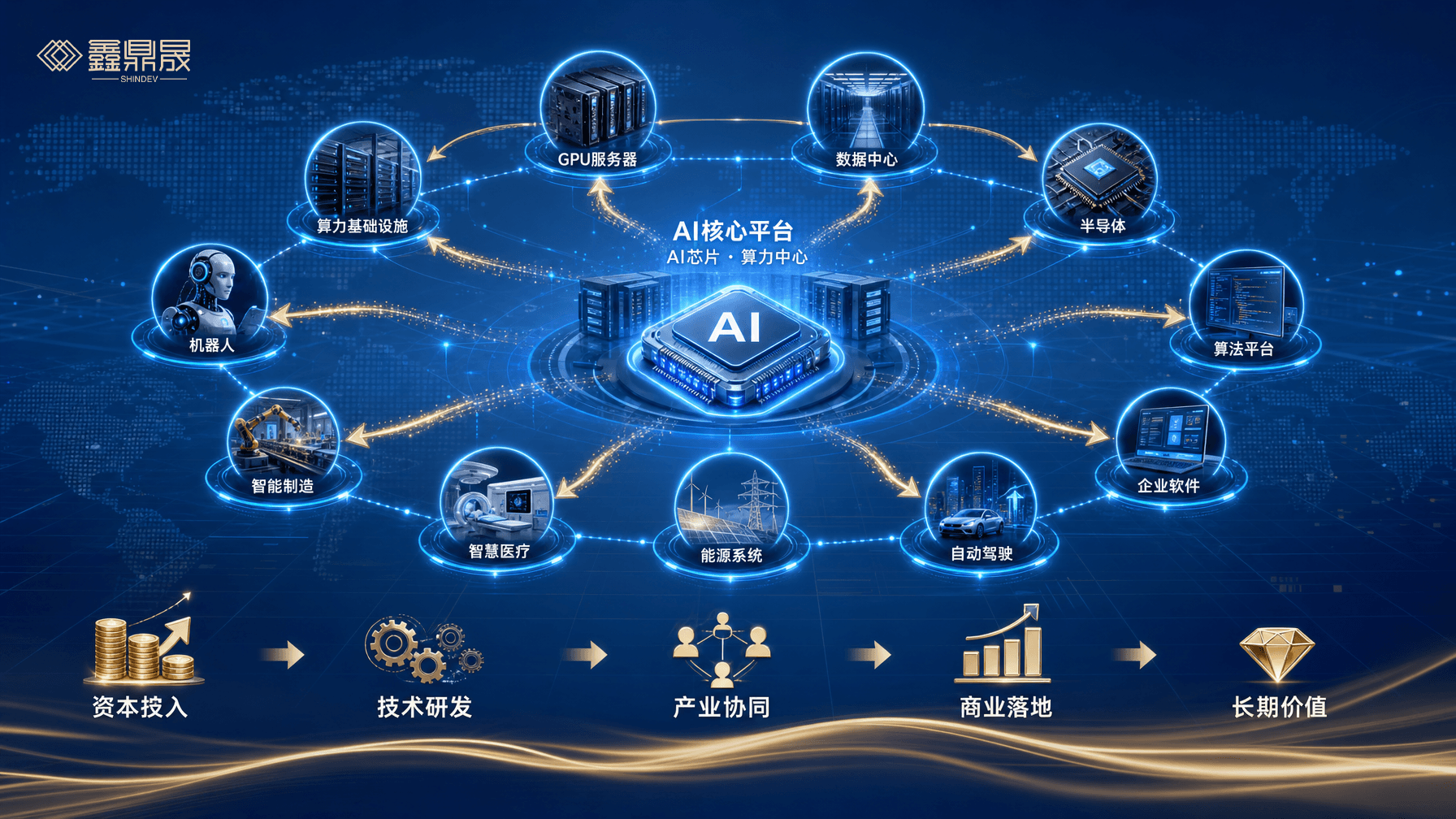
The momentum of the AI industry is already clearly reflected in global capital data.
According to Gartner’s forecast released in May 2026, global AI spending is expected to reach USD 2.59 trillion in 2026, up 47% year on year. AI infrastructure spending is expected to reach USD 1.43 trillion, accounting for more than 45% of total AI spending and becoming the largest market segment. Gartner also noted that AI-optimized servers, AI networking, AI processors, and related infrastructure will continue to expand in the coming years.
The 2026 AI Index Report released by Stanford HAI also showed that global corporate AI investment more than doubled in 2025, while private investment grew 127.5%. Generative AI remained one of the areas with the highest concentration of capital, with related investment increasing by more than 200%. At the same time, global enterprise adoption of AI continued to accelerate, as AI moved from a technical tool into business operations and industrial processes.
These figures show that competition in the AI industry has entered deeper waters. The focus of capital is shifting from individual models and applications toward underlying capabilities such as computing power, chips, data centers, enterprise software, industry solutions, and intelligent terminals. Whether AI can truly create industrial value depends on whether it can be continuously deployed, operate reliably, be accessed at lower cost, and generate efficiency gains in real-world scenarios.
For SHINDEV, this is precisely where financial capital needs to play a key role. The development of AI companies requires not only R&D funding, but also industrial channels, scenario resources, strategic partners, and long-term capital support. If financial capital can systematically allocate resources around the industrial chain, it can help technological innovation cross the critical stages from R&D to application, and from product to scale.
If strategic judgment determines direction, operational capability determines whether the AI industry can truly take root.
From the perspective of Zhou Hongbin, Chief Operating Officer of SHINDEV, the core challenge in AI industry development is not technology alone, but how to bring technology into real industrial processes and form a sustainable closed-loop ecosystem.
Today, the AI industrial chain is becoming increasingly complex. Upstream sectors include chips, computing power, cloud platforms, data centers, and foundation models. Midstream sectors include algorithm platforms, development tools, industry models, and system integration. Downstream sectors cover a wide range of application scenarios, including finance, manufacturing, healthcare, education, energy, transportation, and government services. A disconnect in any part of the chain can affect the commercialization efficiency of AI technology.
Therefore, the role of capital in the AI industry is not only to invest in individual companies, but also to promote closer coordination across the upstream and downstream industrial chain. Computing power needs stable application demand. Algorithms need to enter specific business scenarios. Data needs to unlock value within a compliant framework. Application-side enterprises need technology, capital, and operational support.
In this process, financial capital can become an industrial organizer. Through investment, mergers and acquisitions, industrial cooperation, resource introduction, and ecosystem co-building, capital can help different participants form stronger coordination and push the AI industry from “point-based innovation” toward “systematic development.”
This is also why SHINDEV pays close attention to the construction of the AI industrial ecosystem. Opportunities in the AI era do not belong only to single technology leaders. They also belong to platform-type participants that can connect technology, scenarios, capital, and operational systems.
Whether the AI industry can create long-term value ultimately comes back to products and scenarios.
From the perspective of Li Zhiqiang, Chief Product Officer of SHINDEV, the real competitiveness of AI products does not lie in whether the concept is novel, but in whether they can solve specific problems, improve user experience, enhance organizational efficiency, and form replicable and scalable business models.
Over the past period, market attention around AI has focused more on large models, agents, and generative content. As the industry matures, however, enterprise customers will pay greater attention to the stability, security, cost structure, deployment efficiency, and actual output of AI systems. In other words, AI products cannot remain at the demonstration level; they must withstand the tests of business processes, customer needs, and commercial results.
This also means that opportunities in the next stage of the AI industry will appear more often in vertical scenarios. Intelligent financial risk control, intelligent investment research, enterprise knowledge management, intelligent manufacturing, medical decision support, energy dispatching, urban governance, and cross-border services may all become important areas where AI releases value.
For financial capital, judging the value of an AI company cannot be based only on technical parameters and financing momentum. It is also necessary to examine whether its products address real demand, whether customers are willing to pay continuously, whether delivery capabilities are stable, and whether industry barriers are clear. Only AI technologies that have completed scenario validation can truly settle into industrial value.
Facing the new cycle of the AI industry, SHINDEV positions itself as an important connector between technological innovation and industrial resources.
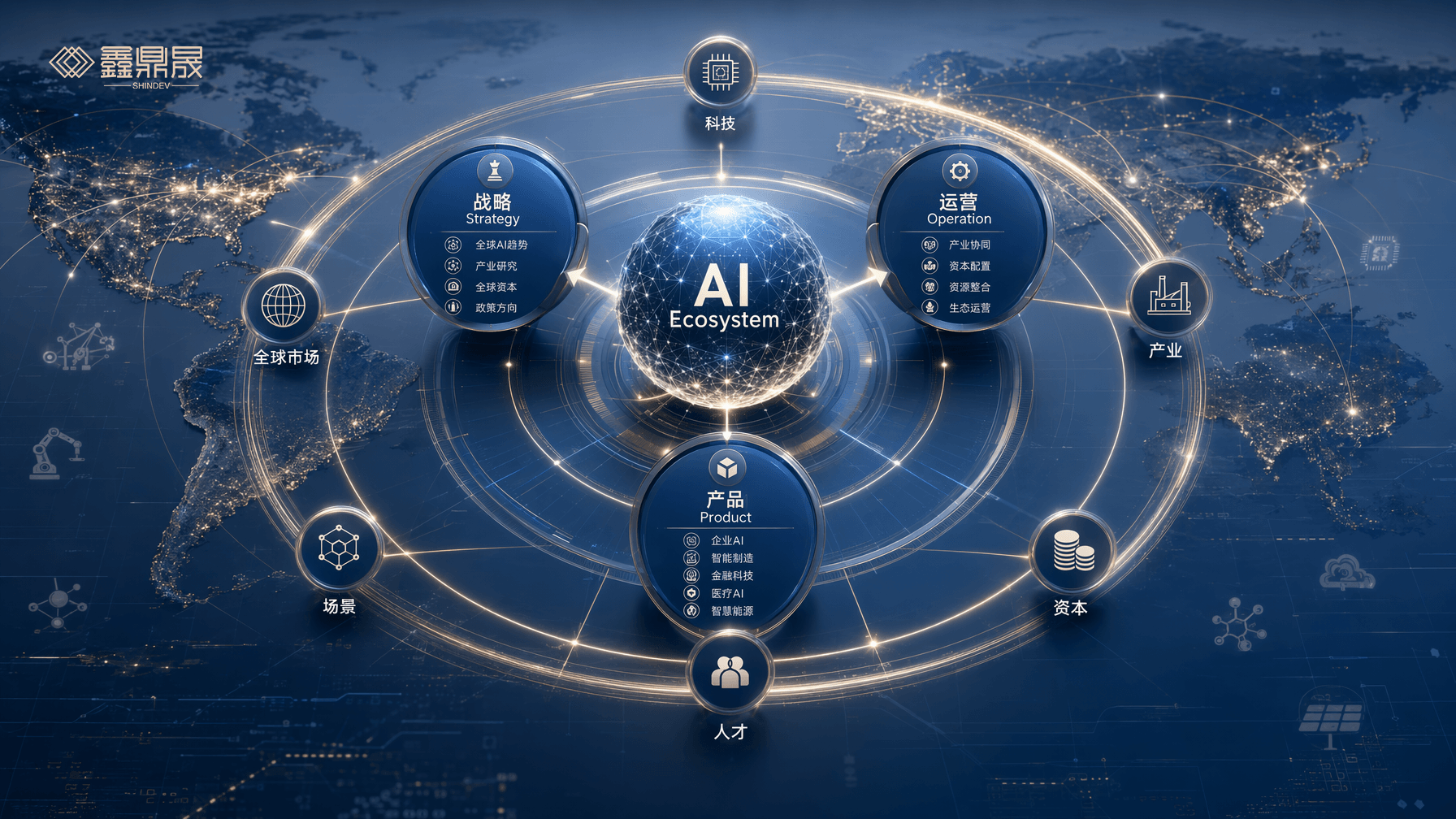
From the multidimensional perspectives of Chen Rui, Zhou Hongbin, and Li Zhiqiang, SHINDEV’s understanding of the AI industry is not limited to individual investment opportunities. It focuses more on the systematic coordination among technology, industry, capital, and products.
At the strategic level, SHINDEV pays close attention to global AI development trends, policy directions, capital flows, and industrial competition patterns, in order to identify where long-term value will form.
At the operational level, SHINDEV focuses on the coordination efficiency of upstream and downstream resources in the AI industrial chain, promoting higher-quality connections among capital, technology, scenarios, and enterprises.
At the product level, SHINDEV focuses on the implementation capability of AI in real industries, emphasizing application scenarios, business models, and long-term user value.
Together, these three perspectives form SHINDEV’s core logic for understanding the AI industry: AI is not an isolated technology track, but a new industrial ecosystem jointly driven by infrastructure, industrial applications, capital support, and global collaboration.
Looking ahead, SHINDEV will continue to build on a global perspective, focusing on key areas such as artificial intelligence, advanced manufacturing, the digital economy, computing infrastructure, green energy, and technology finance. It will continue to study the evolution of industries, connect high-quality innovation resources, support the growth of technology companies, and promote more precise financial capital services for the development of new quality productive forces.
The World Artificial Intelligence Conference in Shanghai not only showcased the latest trends in global AI technology development, but also further highlighted China’s important role in AI industrial development, international cooperation, and global governance.
For enterprises, AI brings more than changes in technical tools. It is systematically reshaping industrial organization, resource allocation, and business growth models. For financial capital, the arrival of the AI era also means that capital must possess stronger industrial understanding, longer-term support capabilities, and more efficient resource integration capabilities.
SHINDEV believes the true value of financial capital lies not only in providing funding, but also in helping technological innovation find industrial pathways, helping outstanding enterprises gain growth resources, and helping frontier technologies transform more quickly into real productive forces.
Capital links technology, and intelligence powers the future. Standing at a new starting point for AI industry development, SHINDEV will continue to empower the construction of the AI industrial ecosystem with a global perspective, long-termism, and professional capital capabilities, working with more innovative forces to promote high-quality development in the digital-intelligent era.